
Stephen Witt: The Thinking Machine. Jensen Huang, Nvidia, and the World's Most Coveted Microchip (2025) 📚
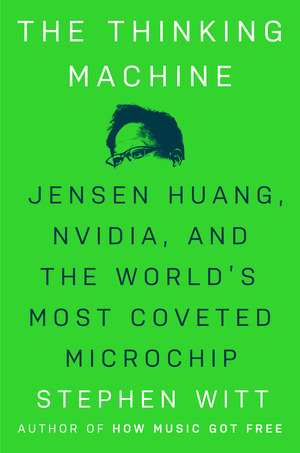
The Thinking Machine by Stephen Witt outlines the rise of Nvidia, currently the most valuable company in the world, from the point of view of Jensen Huang, its CEO and one of the founders.
Jensen, or Jen-Hsun, as his Taiwanese name originally was written, was sent by his parents to the United States in 1973 when he was just ten, along with his brother Jen-Chieh (“Jeff”) who was twelve. He survived bullying in the notorious school he ended up in and later made friends with fellow nerds in the more welcoming high school. There, he also learned table-tennis, eventually playing at the national level.
In university Huang majored in electrical engineering, learning to design microchips. His first job after graduating was at AMD, from where he moved on to LSI Logic after two years. There, he met two brilliant chip designers from a customer, Sun Microsystems: Curtis Priem and Chris Malachowsky. When Sun declined their idea of a dedicated graphics accelerator card for gamers (they made serious hardware for serious people!), the three founded Nvidia.
By this point the book has progressed for just two chapters out of 23. The subsequent chapters detail the development of new generations of Nvidia’s chips, and how they almost went bankrupt too. The book ties the microchips to the games of the time, mostly the various editions of Quake, its designer John Carmack and top player fatal1ty, and how they drove the chip design and marketing.
Chapter six is suddenly about a neural net that played backgammon in 1997, not even mentioning Nvidia or Huang at all. This foreshadows the theme that becomes dominant for the second half of the book and hints at why Nvidia is now so valuable: artificial intelligence. To get there, however, Nvidia still had to develop parallel computing capabilities like never before, and Huang had to bet on R&D projects with no obvious payouts.
The book paints a picture that if, before 2012, you introduced yourself as a parallel computing researcher, you’d be regarded as an academic weirdo. If you introduced yourself as a neural network researcher, you’d be at best ignored and at worst outright ridiculed. If you tried to combine neural networks and parallel computing, people would just refuse to have anything to do with you. This all changed almost overnight when a shy weirdo from the University of Toronto, Alex Krizhevsky, along with Geoffrey Hinton and Ilya Sutskever, trained a neural network in his bedroom with two Nvidia GPUs. This particular neural network completely crushed its competition in the ImageNet 2012 image recognition competition with a wide margin.
From that point on everyone who wanted to train neural networks suddenly wanted lots and lots of Nvidia hardware – either buying it or renting it. There is this brilliant little site called Is AI Profitable Yet? that tracks how much money companies have poured into AI and how much revenue they’ve gotten out of it. Currently, Nvidia is hands down the clear winner, making hundreds of billions, while companies like Google, Amazon, and Microsoft are only losing money.
The book is an interesting look into one part of the history of personal computing, much like the autobiography of Sir Tim Berners-Lee I read earlier. It’s also great at shining some light into how Nvidia got to where it is now.
Jensen Huang himself, however, stays somewhat distant in my opinion. It’s frequently described that he likes to explode at his employees in front of everyone else, making it “educational” and “motivating” people to give their absolute best. Nvidia seems to have attracted the kind of talent that doesn’t mind a bit of abuse from their boss every now and then. Huang is also described as highly intelligent, and to be working all the time, replying to any email sent at any time within minutes. So what drives him? His net worth is beyond anyone’s wildest dreams already. He’s not an idealist trying to save the humanity by colonizing Mars or something, certainly not. It appears to me that he’s just into problem solving, and he likes the kind of problems that can be solved by throwing more compute into them. Or maybe not even that: he just likes to be the one to enable even more computing power. To him it seems all the same what his chips are used for. Is he an empire builder? Or like Walter White in Breaking Bad, is he just in the “money-making business” at this stage? Huang doesn’t have a second in command or any clear successor in the company, so is he just considering Nvidia his legacy, pumping it up to be his own monument? Whatever the case might be, the book is still worth the read!