
Tim Berners-Lee: This Is For Everyone (2025)
I consider myself quite lucky to have seen the time when computers were still pretty basic and the internet was almost unheard of. The first computer I interacted with had a small monochrome display and two 5.25" floppy drives. The family story goes that I broke its keyboard by hitting it very hard when I was just one year old. A few years later we got a slow modem which made it possible to connect to bulletin board systems (BBS), but the world was still simple with no Web, no search engines, and no attention economy.
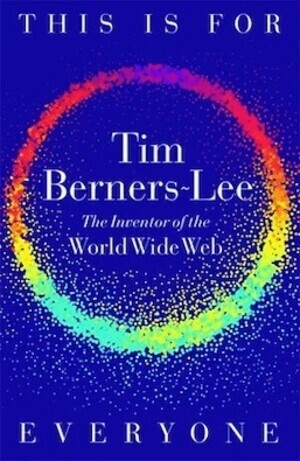
That was a roundabout way of saying I really enjoyed This Is for Everyone (2025) by Sir Tim Berners-Lee, as the book is quite a trip down memory lane. Sir Tim is the one who invented the World Wide Web while working at CERN in 1989. He had the idea of using hypertext to link between different servers and came up with HTML, HTTP, URLs, and the first browser and web server. 📚
The book is engaging and well written, chronicling the history of the web from its inception to the present day, including AI and all. Sometimes it was even a bit difficult to read due to all the rabbit holes I fell into while turning the pages and learning something new, wanting to check out more info on the subject immediately, but that’s just a compliment! 😅 The main focus of the book is the Web, of course, but Tim’s personal life is intertwined nicely within to break the more technical flow. And when I say “technical” I just mean the Web side – I found the book very accessible and not, in fact, overly technical in the traditional sense.
The book also shows how Tim didn’t “just” invent the Web, but how he’s also a true humanitarian, remarkably humble, an idealist, and even an adventurer. He persuaded CERN to give the Web away for free but remained deeply involved, and has been so ever since.
Here in Finland it’s a bit of a national meme to celebrate, or at least cry out a silent “yay!”, whenever Finland is mentioned in foreign media in a positive context. Thus, I greatly enjoyed that we had a couple of mentions in this book. First, Tim recalls visiting Helsinki to encourage the Helsinki University of Technology students who had developed the Erwise browser to continue their work, but unfortunately they had no funding for it. Second, he fondly remembers the time he visited Helsinki to receive the Millennium Technology Prize in 2004.
Nowadays Tim is working with the Solid protocol to empower people to take control of their own data and make it interoperable between different systems to enable innovation and trustworthy AI, for example.
I very much recommend this book to anyone, especially if you’re old enough to remember the time before the big social media platforms. But even if you’re not, there’s a good chance you’ll enjoy it if you’re reading this review in the first place, because it suggests you already appreciate the small web.