games
City builders
I like my city builder games as much as the next guy. I’ve played them since SimCity 2000 and earlier this year wrote about TheoTown already.
Last week I stumbled upon this guy jamessimo on YouTube who’s creating the city builder of his dreams: a game with no grid whatsoever, with parcels of land of arbitrary shapes and sizes. Traditionally these games have been strongly grid-based, even if Cities: Skylines popularized a method where your roads can curve freely, yet the buildings next to them are always placed on a (rotated) grid.
I really like jamessimo’s clear and calm explanations of the systems in his game. He’s an experienced software engineer by trade and has already been working on his game for a couple of years. There’s a part 2 of his series already available as well, detailing his traffic simulation model.
While looking into city builders I discovered there is, of course, a city builder subreddit, r/CityBuilders. There, someone had recently announced a new game called Traffic Architect which I ended up playing on my phone for quite a while. It’s a sub-category of city builders, I guess, where you only focus on making the traffic flow as efficiently as possible. New buildings pop up, new pieces of the map open up, and you unlock new road types. Eventually the game ends once your road network is gridlocked enough. The game reminds me of Mini Metro, or maybe more accurately Mini Motorways. Traffic Architect is also coming to Steam as an improved version, but the browser-based game will stay free, the author says.
How to build an airport in TheoTown
A while back all the windows in our apartment were replaced, which necessitated that we clear the space in front of the windows. This included the table on which my desktop PC is located and that my kid uses to play Cities: Skylines II, so we needed a temporary replacement city-builder for mobile. I had heard of this game called TheoTown and went with that, and it turns out it feels immediately familiar for those who have played city-builders, especially of the older type like SimCity 2000, which is nice.
In the game I, for some reason, found it very unintuitive on how to build an airport. You cannot just plop it down and be done with it, no, you need to place all the runways and individual buildings separately. So, in case you’ve ever wondered how to build an airport in TheoTown, here’s a set of detailed instructions on how exactly to do that.
Elevator Saga game
Robot Battle, an old Windows game
How NetHack got me into the Battlefield series
NetHack is a notoriously difficult game that some people play for decades and never win, even if they have all the spoilers available. I used to play it a lot some twenty years ago.
The game may not look like much; in fact by default it consists only different characters and symbols of different colors: you are the @ symbol, a grey d is your dog, a purple capital letter is some highly dangerous monster, a brown % is food, and so on. It takes a bit of imagination, but once you’re fully immersed into the game, even looking at your own email address may send shivers down your spine because it looks like you’re in a narrow corridor surrounded by monsters.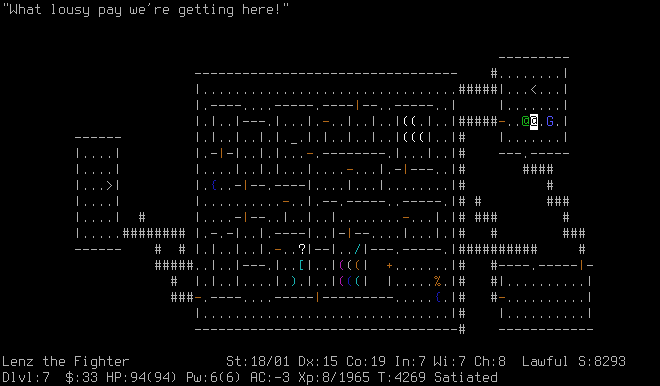
The goal is to descend down a perilous dungeon, retrieve a powerful magical item called the Amulet of Yendor, come back up, get to the Elemental Planes and the Astral Plane, and finally offer said amulet to your deity, who will grant you the gift of immortality in return. This called ascending the game, i.e. ascending to demigod(dess)hood.
So, how did NetHack get me playing the Battlefield series, then? Battlefield is a series of first-person shooter games that has always been bragging with some cutting-edge graphics, so it couldn’t be much farther away from NetHack.
Wordle
Today I reached a streak of 100 in Wordle. 😃
Wordle 1,352 4/6

⬛⬛⬛🟨⬛
⬛⬛⬛⬛🟨
⬛⬛🟨⬛🟩
🟩🟩🟩🟩🟩

WordleBot
Skill 90/99
Luck 46/99

Clash Royale
Supercell is a successful Finnish mobile game company known for Clash Royale, a strategic real-time card game where players use various units to defeat opponents' towers.