
PlayAeon.eu: An epic match-3 journey through time
A while back the rest of my family got hooked on some match-3 games, mostly Royal Match. The game is annoyingly addictive, and you might have limited attempts before the game makes you wait for a while – unless you pay, of course. So, I figured, why don’t I just vibe up a new match-3 game without all those dark patterns? How hard could it be?
TLDR: Try my new game at PlayAeon.eu!
Turns out, it’s both easy and difficult at the same time. My first issue was, what should the theme of the game be? It seemed that all the obvious answers had been done: candies, fruits, fish, gemstones, birds, etc. Then I asked Chad for any non-obvious themes and it listed several like microbes, planets, and clockwork pieces. That’s when I started to see an idea of an arc: why not have several chapters with a theme of their own in each one? The game could be about the history of the Earth and progress through all the phases of it, from its formation through the dinosaurs, and to the space age.
The mechanics of the game could also change per chapter: something could be added, something could be taken away. I played with these thoughts a bit and then asked Chad to give me a prompt to give to the Work agent. I added the requirements that the game must look beautiful, comparable to the best “AAA” mobile games, and that it would indeed have to be developed with the mobile first mindset. Chad delivered a long and ambitious product-discovery + technical-prototyping brief, about 1100 words, which I then gave to the Astra model. Astra crunched for 20-30 minutes and indeed delivered a beautiful prototype of a game called Aeon: Deep Time with three different chapters. I was immediately hooked.
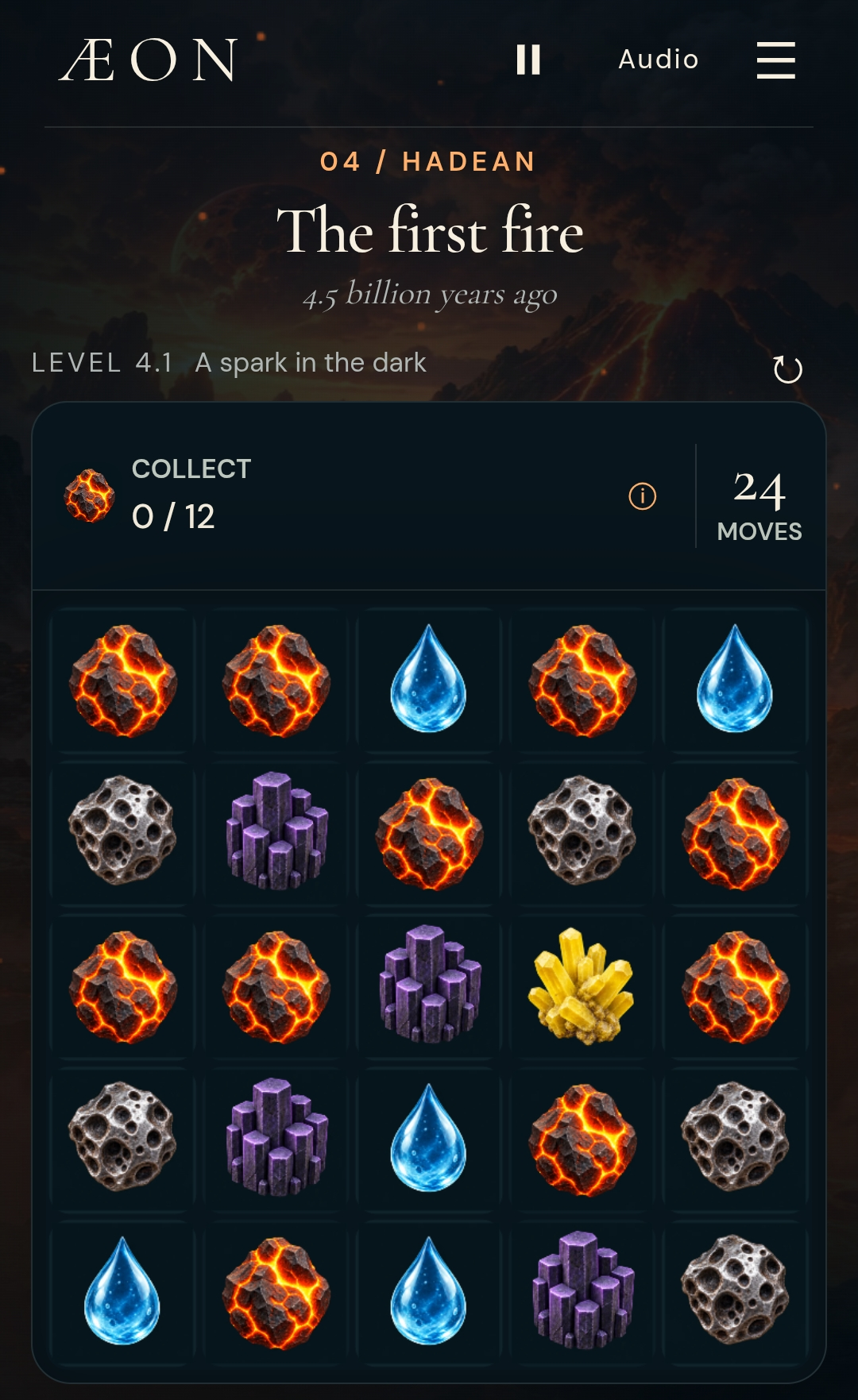 One of the original levels, now part of the fourth chapter.
I continued iterating on the game, adding new features and levels. Sometimes I had a strong vision of a chapter I wanted, sometimes I spotted a big gap in the timeline and asked Chad for ideas on how to fill it, picking the ones that sounded the most interesting and distinctive. Chad was good at coming up with ideas for new mechanics, but the hard part was when I had to playtest them all and see if they were actually fun. One particular idea I had to abandon, for example, was that you’d have to have a certain type of tile in a certain square of the board and make a match just there. That only became an exercise in frustration when the random number generator (RNG) just wouldn’t give me that type of tile in the required column. This idea was, however, carried on in a relaxed format to some levels where there are special static squares and you need to match a particular tile type anywhere next to them, which is much easier than requiring a tile to be in an exact square.
So, implementing new features was generally easy, but coming up with ideas and playtesting them was hard, or at least time-consuming. I could ask for a new feature when leaving for work, and by the time I had walked to the train station, I would have a new playable prototype for the train ride.
As of writing this, the game is in version 240 already, and given I’ve developed this now for about a month and a half, it comes to five or six versions per day. Not all of them required extensive playtesting, of course: they could’ve been minor tweaks to wording or graphics, but then again some versions delivered, for example, several new levels. Also the number of prompts I’ve used is probably north of 500 already, given all the planning and how each prompt does not necessarily create a new version of the game.
One of my chats even ran out of space so that Chad just wouldn’t accept any new messages from me. On a few other occasions Chad wouldn’t respond to me at all for a couple of hours, even though their status page was always green. At other times Chad would get internally broken somehow, losing connection to its own Git repository! That was often solved by starting a new chat, though.
To aid the debugging at some point I added a playtest log feature which logs various key figures of the game, like the number of possible moves at every point. Then, when I thought a level wasn’t feeling good to play, I could export the test log and give it to Chad, and I’d have hard data to tell me that yes indeed, you averaged only 1-2 available moves through the level, so no wonder if the experience felt constrained. Then I’d adjust the number of tile types, or the size of the game field, or the position of static squares, and try again.
I don’t remember how many chapters or levels I imagined the game would originally have, and I don’t want to spoil the surprise now, but suffice it to say there’s plenty, a few hours' worth of gameplay. The chapters are definitely shorter than I originally imagined, but I find this is what keeps the game interesting when you get a new set of graphics and mechanics more often than not. I’ve probably become blind to some issues that a new player would notice immediately, but the game is now in a state where I’m quite happy to present it as it is. 😃 I’d also be even happier if I got any feedback regarding it. So, please, try Aeon: Deep Time and let me know what you think!