Titanic tidbits
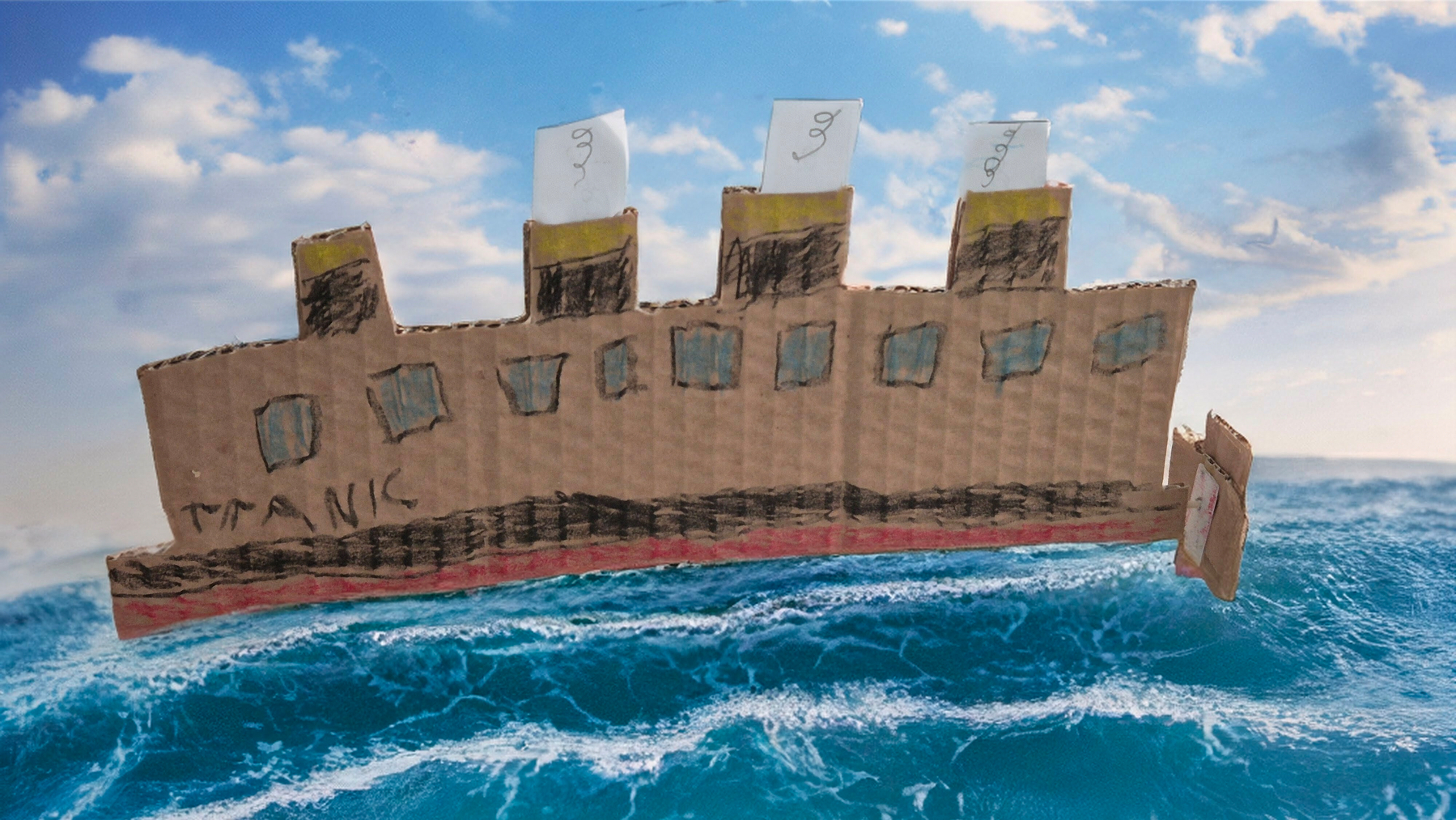
My 5yo kid is having a Titanic phase: he wants to know everything about Titanic, draws or builds at least one Titanic every day, etc. This has, as a side effect, forced me to learn some new (to me) details about this famous ship too, so I decided to just gather a concise package of Titanic info here.
The Titanic was commissioned by the British company White Star Line – headed by J. Bruce Ismay – and was assembled by Harland & Wolff in Belfast, Ireland, with Thomas Andrews as the chief naval architect. It was the middle one of three, almost identical Olympic-class ships: the first one to be completed was the Olympic, and the last one the Britannic. The timeline of the Titanic, captained by Edward John Smith, goes as follows:
- 1909-03-31: The construction of the Titanic began
- 1911-05-31: Titanic was launched (basically as just a floating hull, construction continued)
- 1912-04-02: Titanic was accepted by White Star Line from Harland & Wolff after successful (albeit short) sea trials
- 1912-04-03: Titanic arrives in Southampton just before midnight, ready to accept passengers and cargo
- 1912-04-10, noon: Titanic departs Southampton
- 1912-04-10, evening: Titanic makes a stop at Cherbourg, France
- 1912-04-11, noon: Titanic makes its final stop at Cobh (then known as Queenstown), Ireland, and then continues towards its ultimate destination of New York, USA
- 1912-04-14, 23:40: Titanic hits an iceberg 37 seconds after the berg is spotted
- 1912-04-15, 02:20: Titanic sinks
- 1912-04-15, 04:00: RMS Carpathia arrives from 100 km away to pick up the ~705 survivors
- 1985-09-01: The wreck of the Titanic is found in two pieces roughly 600 meters apart
Approximately 1500 people died in the accident. The small silver lining is that the ship was carrying roughly 1100 fewer people than its maximum capacity, as the White Star Line had not managed to sell all the available tickets.
Besides Titanic and Carpathia, another ship you hear about is SS Birma. Birma was about 185 km away from the scene when it began receiving distress calls from Titanic, and also set course for the scene immediately. They would only have arrived around eight in the morning, but once close were apparently told by Carpathia that no further assistance was needed.
The most unfortunate ship related to the accident, however, was in my opinion the SS Californian. They had stopped for the night because of the iceberg danger and actually even saw Titanic’s white emergency flares, but for some reason failed to recognize them as such and to act at all. Their radio operator Cyril Evans had also gone to sleep already and turned the system off. Earlier on the 14th he had warned the Titanic about the icebergs, but Titanic’s radio operator Jack Phillips had been busy sending the passengers' telegraphs and had just told Evans to shut up. (Note that while this sounds rude by today’s standards, it was apparently business as usual back in the day.)
The Titanic had, in fact, also received several other warnings about ice from other ships as well, and had slightly altered her course, but had maintained her speed anyway. Californian’s radio operator Evans woke or was woken up around 05:15 - 05:30, at which point they learned from SS Frankfurt that the Titanic had sunk. (Frankfurt was the first ship to respond to Titanic’s distress calls, from 250 km away.)
Talking about radio, Titanic had a state-of-the-art system by Marconi. The operators, Phillips and his junior operator Harold Bride, were also supplied to the ship by Marconi. Titanic’s call sign was a Marconi-assigned code of three letters starting with an M, MGY, which can be seen in the transcripts of Titanic’s radio communications. Birma’s call sign was SBA, Carpathia’s was MPA, Frankfurt’s DFT, and Californian’s MWL.
About the other combinations of letters, Titanic’s full name was RMS Titanic, where “RMS” stands for Royal Mail Ship, i.e. a British ship that had an official contract with the British Post Office to transport mail and parcels (in addition to passengers). This set some constraints to the ship, like having a regular schedule, but it was also lucrative for the operator. SS Birma and SS Californian, however, were just steam ships, so “SS” has no special meaning beyond “this ship is steam powered”. Titanic’s older sister was also called RMS Olympic.
Interestingly, their younger sister Britannic was meant to be designated as RMS Britannic too, but as the First World War started, the Royal Navy acquired the ship even before it was fully finished and designated it as HMHS Britannic: His Majesty’s Hospital Ship Britannic. Britannic was finished in December 1915 but sank less than a year later in November 1916 after hitting a German naval mine in the Aegean Sea. Amazingly, it sank in only 55 minutes, yet 1036 of the 1066 people aboard (97%) were rescued, because this time there were enough life boats and the evacuation procedures had been rehearsed – but also because the visibility was good, waves calm, and the sea water temperature was survivable.
Nearing the end of this post, I just mentioned the infamous life boats. The Titanic indeed did not have enough life boats for everyone: there were 20 of them with a total capacity of 1178 people, only a little over half of the people on board that night. However, the rules of the time dictated the number of the life boats by ship tonnage, not the number of passengers, and the disaster model was that a ship would float for long enough for another ship to come by and either offer its life boats as additional help, or could unload the boats of the ship in distress and send them back for more people. With this in mind, the Titanic actually even had more life boats than was needed according to the regulations. Yet, many life boats were sent off from Titanic as severely underused, thanks to poor training of the staff. One glaring example of this is life boat 1 that had the capacity of 40 but only carried 12 people.
And finally, regulations bring me to my last point. Both British and American investigations were launched after the disaster. It all culminated in 1914 with the International Convention for the Safety of Life at Sea (SOLAS) treaty that dictated, among other things, the number of life boats and their usage drills, certain ship construction standards, and emergency radio protocols, making seafaring much safer for future generations.
Oh, but what happened to RMS Olympic? It survived the war as the troopship HMT Olympic, then served successfully as an ocean liner for years before being decommissioned in 1935 and later sold for scrap.